This article examines the potential of alternative bathroom configurations that extend beyond the confines of the individual dwelling. While contemporary residential construction is characterized by the formation of standardized bathroom types shaped by technical and normative requirements, film-based bathroom portraits from the user’s perspective document a diverse range of bathing practices. These range from private bathrooms located outside the individual dwelling and improvised substitute bathrooms to shared sanitary facilities at campsites and fragmented bathroom arrangements in student residences. The article explores a range of design possibilities that foreground flexibility, communal use, and individual suitability in residential construction. Variations in privacy, the potential for parallel use, and the spatial decoupling of bathroom and apartment point to a design potential that has so far remained largely untapped. The article argues for a broader spectrum of bathroom configurations that accommodate different lifestyles, comfort expectations, and forms of cohabitation, while also creating opportunities for shared use and community.
Compared to technological and social change, our housing forms and buildings remain comparatively rigid. Within the home, furniture allows us to reorganize space and, to a limited extent, adapt it to our own ideas of how we want to live. By contrast, the bathroom – particularly in multi-unit housing – remains largely beyond users’ control. Its fixed connection to water supply and wastewater infrastructure, together with extensive regulatory requirements, leaves little room for spatial or functional [RP1] adaptation.
Contemporary bathrooms are largely shaped by the spatial demands of accessibility, fixed fixtures, standardized constructions and surfaces, and significant cost pressures. These conditions invite a critical reconsideration of prevailing bathroom layouts and usage concepts, as well as an exploration of a spatial domain that remains curiously underexamined in contemporary residential construction. This neglect is striking given that hygiene is a basic human need whose spatial organization and relationship to living have repeatedly changed over time, yet currently receives little attention in multi-story housing [1] . Architectural history – and everyday experience – demonstrates how shared moments of intimacy in bathing spaces can be both lively and meaningful, from historic public bathhouses to the mundane ritual of brushing one’s teeth together at the bathroom mirror.
This article starts from the assumption that emerging forms of living are redefining the boundaries of the individual dwelling. What spatial and social potentials do bathrooms located beyond this conventional boundary offer in terms of flexibility, diversity, and communal use? Broadening the view beyond the dwelling – to shared sanitary facilities at campsites, bathrooms in student residences, or individually negotiated arrangements – reveals points of reference for alternative bathroom concepts that operate primarily, though not exclusively, outside the dwelling. The focus lies on bathing spaces that depart from the standard model of a closed and clearly defined room and instead illuminate the diversity of existing and possible future bathroom practices.
Because bathroom portraits are not a widely established genre, bathrooms and their use are typically perceived only through one’s own experience; accordingly, this view is shaped by personal habits and expectations. User-centered portrayals [2] , by contrast, make it possible to enter unfamiliar bathing spaces and to grasp their specific qualities. Even when such examples do not translate directly into design solutions, they provide vivid points of departure for architectural discourse and design practice.
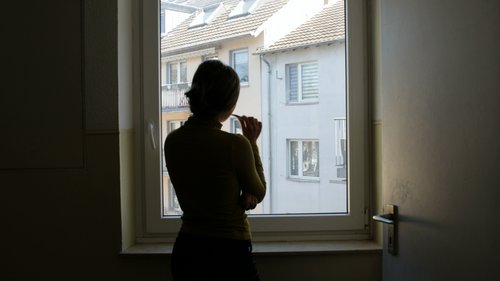
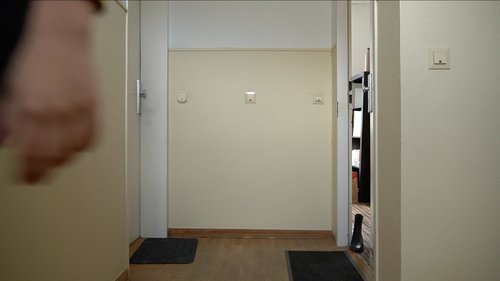
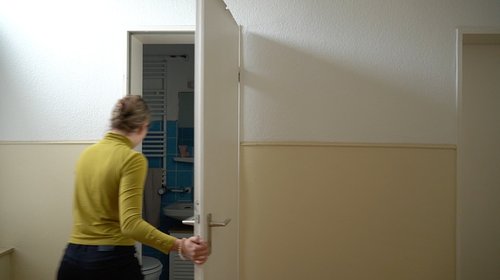
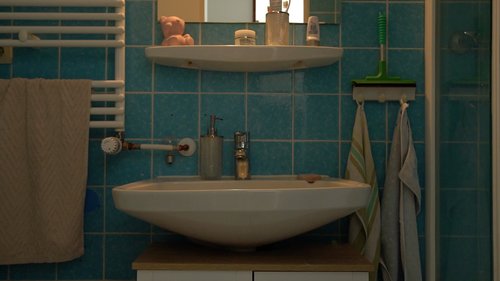
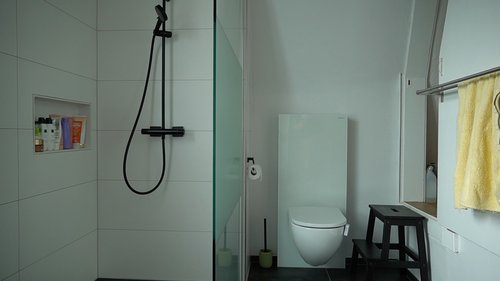
Elli does not mind that her small bathroom has no window, as she can use the hallway to brush her teeth. She leaves the bathroom door open to allow air to circulate and looks out through the large window into the stairwell, watching what is happening outside. During the day, her neighbors in the apartments above are frequently out, so she feels unobserved and leaves her apartment door open. A shoe placed in the doorway prevents the door from closing. This arrangement is necessary because her private bathroom is located outside her apartment, in the hallway. As a result, she occasionally has to throw something on to use the toilet. At first glance, this floor plan recalls the communal stairwell toilets common around the turn of the twentieth century [3] , which were primarily motivated by efficiency and profit maximization. In this case, however, the convention of the private bathroom is retained, while its placement simultaneously evokes the shared use of the stairwell.
Taken further, private bathrooms located outside the apartment boundary offer a high degree of combinatorial freedom for different apartment layouts, creating what might be described as a “breathing house” – that is, greater flexibility in floor plans that are not constrained by fixed service risers. Because these bathrooms are accessible independently of the occupied apartment, they could accommodate different requirements (such as barrier-free or family bathrooms) and characteristics (for example, natural lighting or a bathtub), and be allocated according to the individual needs of residents.
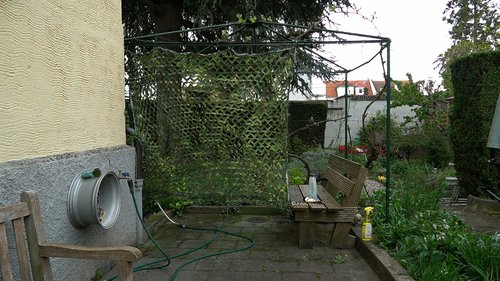
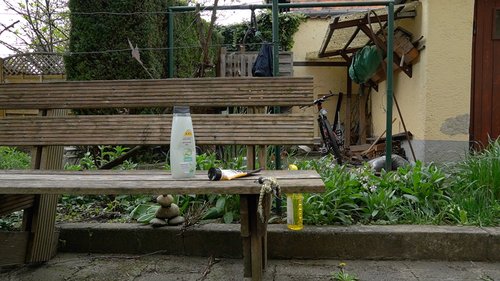
Oliver, a father of two in his mid-fifties, showers every morning beneath a grape arbor in his garden. As long as he uses proper breathing techniques, he does so year-round, making exceptions only on days when temperatures drop below freezing. Asked about this unusual bathing location, Oliver explains that he is “simply too lazy to wipe down the glass pane after showering.”
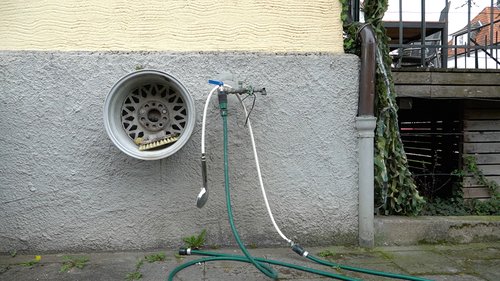
The outdoor shower, consisting of a shower head and a Gardena quick coupling attached to an exterior tap, was initially a temporary solution during the renovation of the family bathroom in the single-family home he shares with his wife and two daughters. After the renovation was completed and the rest of the family returned to the newly modernized bathroom, Oliver continued to shower outdoors. The arrangement had proven effective for him – and, as he emphasizes, only for him. An additional advantage is the high water pressure: connected directly to the main water supply, the outdoor shower rinses shampoo from his hair particularly quickly.
This example illustrates how differing needs within a household can exceed what a single, private bathroom is able to accommodate. Alternative bathing spaces, whether located on balconies, in hallways, or outdoors, can respond to changing requirements related to accessibility or cleanliness. What qualifies as a bathroom, in this context, depends primarily on access to water supply and drainage. Oliver notes that he has no desire to construct a fully self-contained outdoor bathroom. Showering outside saves him work, and simply pulling the shower curtain aside is enough to make the grape arbor available to everyone again once he is finished.
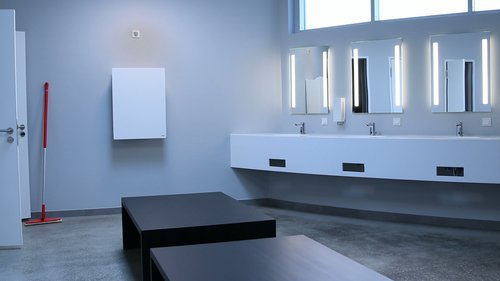
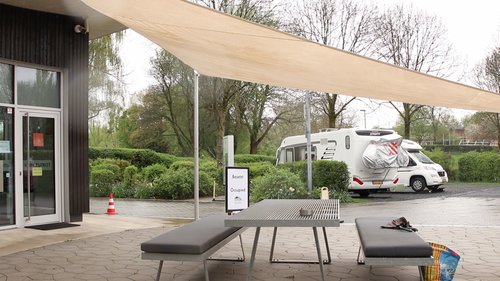
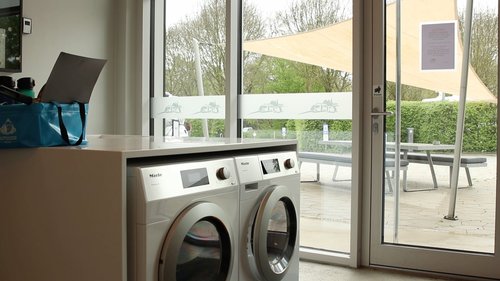
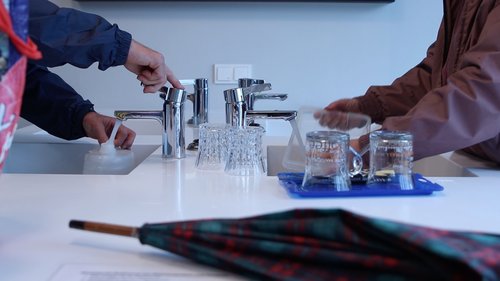
The sanitary facilities at the Bad Aachen motorhome parking site bring people together for activities that would otherwise take place in private bathrooms. In the spacious central washroom, sinks line one wall, with shower and toilet cubicles arranged opposite. The facilities appear new and well maintained. Simple, abstract seating elements are placed in the center of the room.
“You get to know people—not in any deep way, but you do get to know them,” one camper remarks. “It’s funny to see how others brush their teeth.” In everyday camping life, encounters in the communal bathroom are considered valuable. Conversations arise easily, she adds, and brief exchanges are part of the routine.
Here, the decentralized private bathroom in the motorhome is complemented by a central communal facility. “We also have our own toilet (in the camper van). At night or early in the morning, we don’t go to the communal one.” Two forms of comfort thus complement each other: the immediacy of a small private bathroom and the spaciousness of a shared facility equipped for more extended use. The motorhome site functions as a temporary testing ground in which different standards apply – standards that could, in principle, also inform residential construction. Acceptance, however, depends on their specific design. In contrast to experiences at other campsites, one user particularly appreciates the clear separation between toilet and shower areas, including acoustic separation. Without such separation, she notes, “small insects can enter, or you can hear what the person next door is doing.” She also emphasizes that the high level of cleanliness makes the shared bathroom inviting.
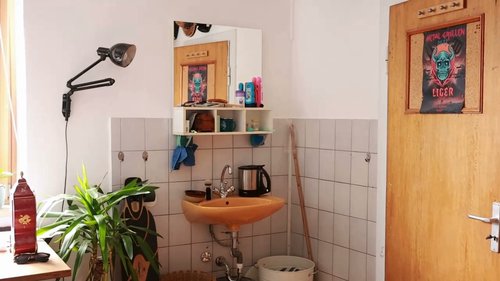
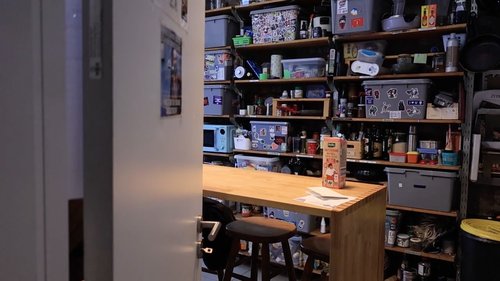
At first, it felt strange to walk through the kitchen to reach the shower, reports a resident of a self-managed student residence in Aachen’s city center – especially since she did not yet know her roommates very well. Over time, however, the arrangement became part of everyday life, and she now finds it hard to imagine living any other way.
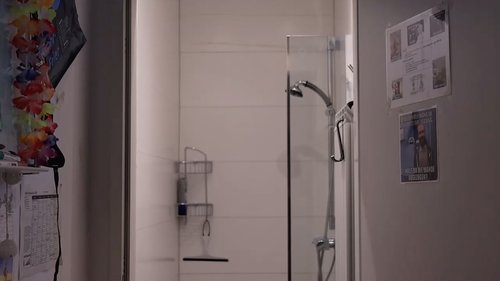
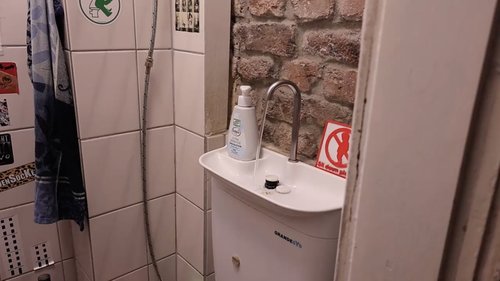
Fixtures that are typically combined within a single bathroom – sink, toilet, and shower – are distributed across the four-story building. Each of the 21 rooms is equipped with a private sink, each floor has a shared toilet, and the two showers are located next to the kitchen on the ground floor. This spatial arrangement creates differentiated zones of privacy across what would conventionally be a single room, while also achieving a high degree of efficiency. Because sinks are decentralized in the individual rooms, morning routines can take place independently and in parallel, allowing the two centrally located showers to serve the building’s 23 residents without waiting times.
The placement of the showers next to the kitchen results from their connection to existing water supply and drainage infrastructure. As an “evolved” configuration, this example illustrates both the potential and the challenges of fragmenting bathroom functions. The shared showers require new habits in negotiating nudity and comfort on the way to the shower, yet they also create recurring opportunities for everyday encounters.
Designing within a pluralistic society means responding to a wide range of values, needs, and ways of living. It follows that no single bathroom type can adequately reflect this diversity, nor would it be feasible or desirable to design a fully individualized bathroom for every resident. Instead, loosening the grip of familiar bathroom conventions, both for designers and for users, makes it possible to conceive alternative bathroom constellations at the scale of the dwelling, the floor, or the building. Within such constellations, residents could choose from a range of options that best suit their respective needs. This approach opens up the possibility of sharing bathrooms not only within families or fixed households, but also among people with similar expectations regarding cleanliness, comfort, or mobility. The intention is not to establish a new norm or to prescribe shared bathroom use, but to expand the range of opportunities alongside conventional bathrooms.
Even if such practices are not embraced by everyone, shared bathroom arrangements can be understood as one plausible extension of contemporary living models. Viewed optimistically, they also hold the potential to once again create spatial conditions in which forms of community can emerge.
Alexander Kira argues that our attitude toward personal hygiene have long prevented this subject from receiving the level of attention it warrants (Alexander Kira, The Bathroom, Viking Press, New York, 1976).
During the summer semester of 2025, as part of the bachelor’s thesis “Redesigning the Bath,” the authors worked with students at the Chair of Housing and Design Basics to document bathrooms on film. Stills from a selection of these films are presented here.
In 1905, around 90 percent of Berlin’s population lived in four- to five-story apartment buildings. Nine out of ten apartments had no bathroom, and in nearly half of them the toilet was located in the stairwell or the courtyard. […] Approximately 42 percent of all apartments consisted of a single room, occupied on average by three people (Karl-Heinz Hüter, Architektur in Berlin 1900–1933, Dresden, 1988, p. 173; translation by the authors).
Alexander Kira argues that our attitude toward personal hygiene have long prevented this subject from receiving the level of attention it warrants (Alexander Kira, The Bathroom, Viking Press, New York, 1976).
During the summer semester of 2025, as part of the bachelor’s thesis “Redesigning the Bath,” the authors worked with students at the Chair of Housing and Design Basics to document bathrooms on film. Stills from a selection of these films are presented here.
In 1905, around 90 percent of Berlin’s population lived in four- to five-story apartment buildings. Nine out of ten apartments had no bathroom, and in nearly half of them the toilet was located in the stairwell or the courtyard. […] Approximately 42 percent of all apartments consisted of a single room, occupied on average by three people (Karl-Heinz Hüter, Architektur in Berlin 1900–1933, Dresden, 1988, p. 173; translation by the authors).


